Brand Guide
David Webb
Founded 1948 · New York
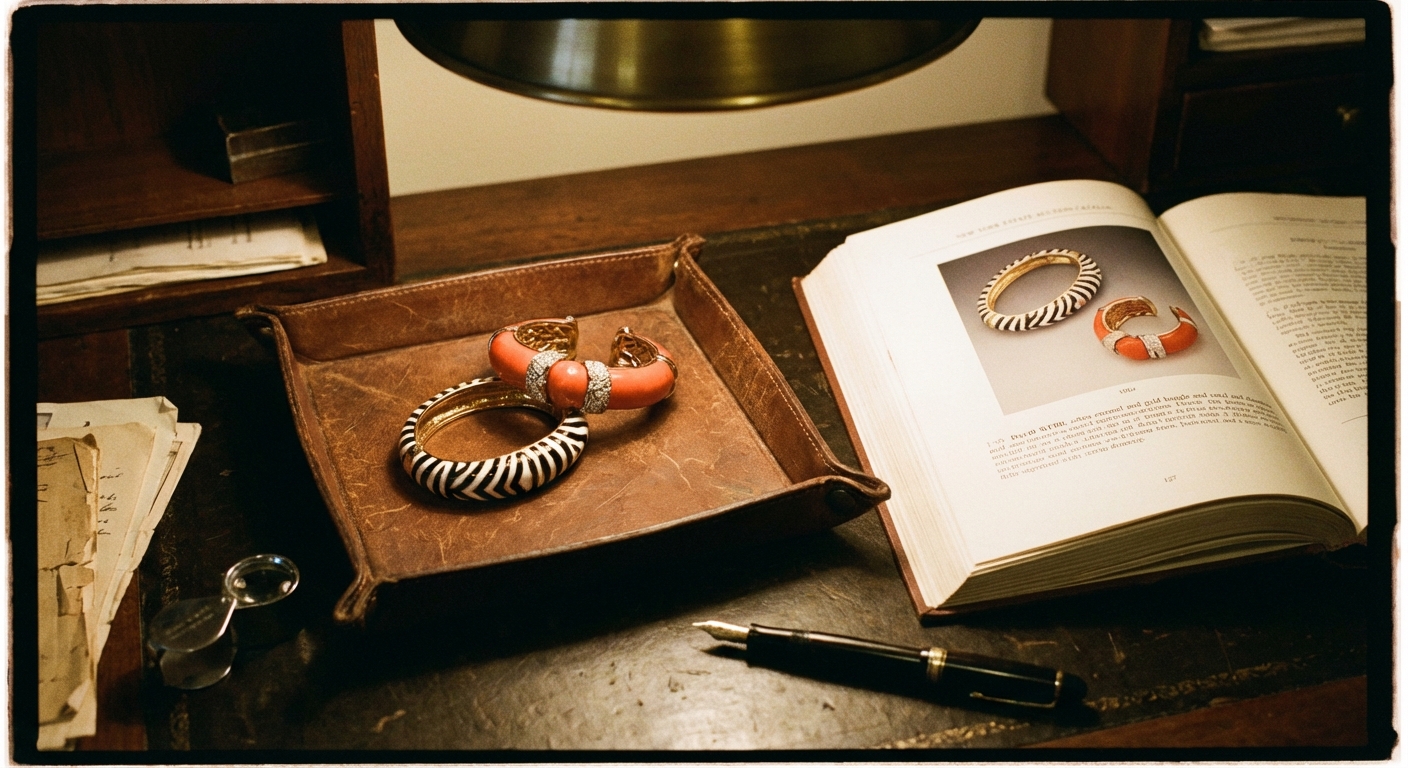
David Webb is the most American of the great jewelry houses — bold, unsubtle, and completely uninterested in European restraint. His pieces announce themselves. The enamel is his signature, and it is extraordinary: vivid, deeply saturated, applied in thick layers that catch light differently than anything produced before or since. It is also his Achilles heel — chipped enamel kills value, and restoration, while possible, is never perfect. The animal kingdom pieces are the trophy category. Frogs, zebras, rams, elephants — Webb created an entire menagerie of jeweled animals that became status symbols in 1960s New York. The zebra bracelet is perhaps the most recognizable: bold black and white enamel stripes, diamond spots, 18k gold construction that feels substantial in the hand. These pieces were worn by the women who defined American style in that era. At auction, important animal pieces command significant premiums over his architectural work. The hammered gold texture is both an aesthetic signature and an authentication tell. Webb used a distinctive hand-hammering technique that creates an irregular, slightly matte surface. This is extremely difficult to fake convincingly because it requires skilled craft execution, not just casting. If the gold surface is too uniform or too mechanical, it's not Webb. Webb is systematically undervalued relative to the European houses. A David Webb enamel cuff of comparable quality to a Cartier Panthère bangle sells for a fraction of the price. The collector base is smaller, more American, and less visible internationally. That's an opportunity. As the 1960s New York aesthetic gets more serious art historical attention, Webb prices are moving. Condition standards: enamel chips are disqualifying for premium prices but don't make a piece worthless — chips in non-visible areas may be acceptable at the right price. The stone quality in Webb pieces is consistently high; he sourced well. Hinges and mechanisms should be checked carefully on cuff bracelets.
From the Spectra Collection


Signature Collections
Enamel Animal Bracelets
1960s–1980sThe definitive Webb status symbol. Massive 18k gold cuffs featuring vividly enameled animals with gem-set eyes. The crispness of the enamel against the high-karat gold is instantly recognizable across a room.
Maltese Cross
1960s–presentBold, architectural cross motifs using stark black and white enamel contrasted with large, high-quality diamonds. These represent Webb's mastery of graphic, high-contrast design.
Hammered Gold
1960s–1980sPure, unadulterated 18k gold with a labor-intensive, hand-hammered finish. This shows Webb's fundamental goldsmithing chops without the distraction of stones or enamel.
Byzantine-Inspired Cuffs
1960s–1980sHeavy, sculptural cuffs inspired by ancient Roman and Byzantine antiquities, scaled up for 1970s society clients. Serious gold weight and imposing presence.
Gem-Set Animal Forms
1965–1985Fully three-dimensional gold and pavé diamond animal statues—lions, elephants, owls. These are the rarest, most complex Webb pieces and regularly anchor major jewelry auctions.
Authentication Guide
Hallmarks
- ◆Pieces typically carry the WEBB or DAVID WEBB stamp, though omission on smaller or highly detailed pieces is entirely normal.
- ◆Stamps often include the 18K and PLAT marks, occasionally positioned subtly within the intricate goldwork.
What to Look For
- ✓Enamel should have exceptional depth and a glass-like finish, though minor wear on vintage pieces simply indicates a life well-lived and often presents a buying opportunity.
- ✓The goldwork feels substantial and weighty, with hand-hammered textures that reflect light warmly rather than looking perfectly machine-flat.
Red Flags
- ✗Metals that test as base materials instead of the indicated 18K gold or platinum.
- ✗Stones that appear glued in rather than properly set with prongs or bezels.
- ✗Overall construction that feels lightweight, flimsy, or lacking the robust, architectural presence characteristic of the house.
Price Ranges
Best value era: 1960s–1970s
What Dealers Look For
Collectors prize original Webb pieces for their bold presence. Enamel condition is a value factor, but minor chips in vintage pieces can offer accessible entry points into collecting this iconic American maker.
Don't let a missing stamp on a smaller piece deter you; look for the characteristic heft, masterful animalier forms, and deep enamel work as your primary guides.
Frequently Asked Questions
Currently Available