Buying Guide
Gemstone Certifications Guide
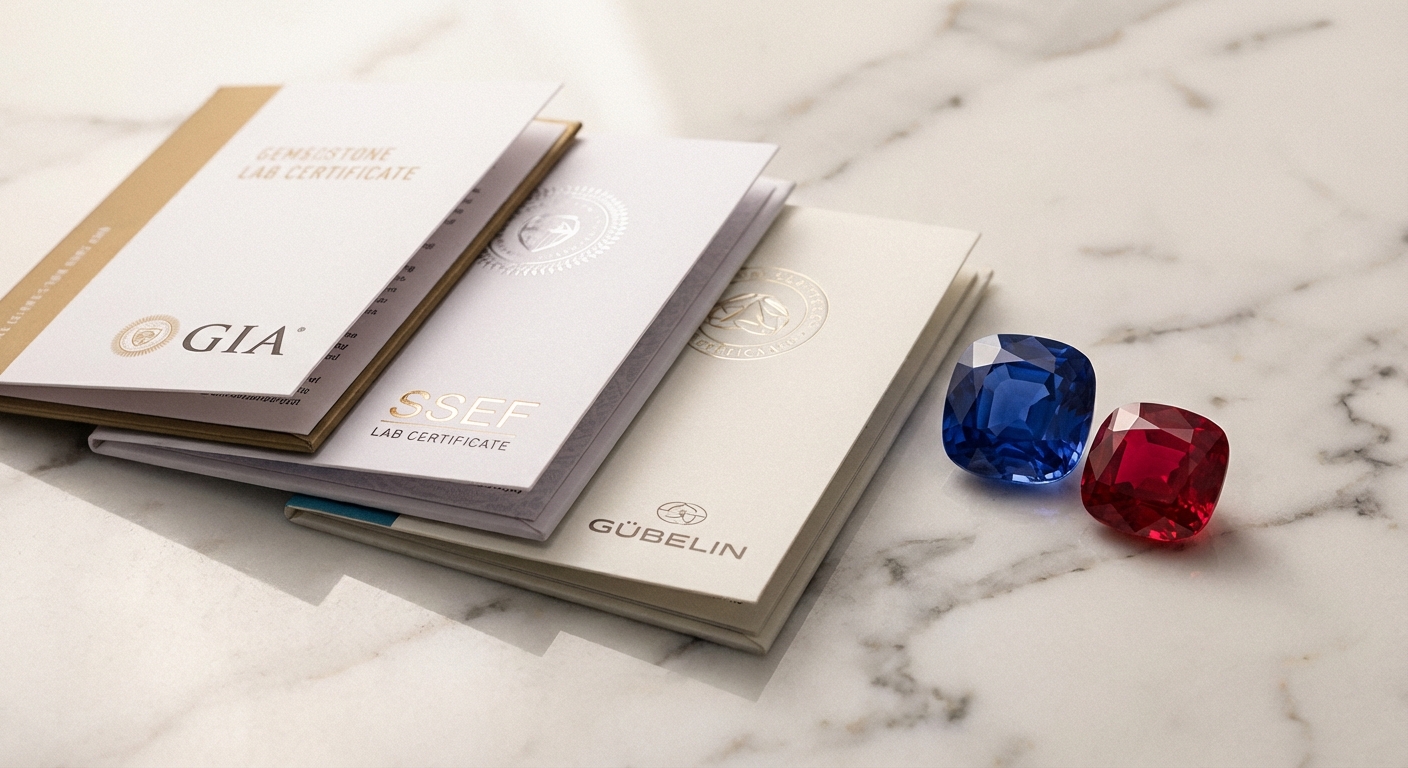
I have passed on more good-looking stones because of bad certificates — or no certificates — than for any other reason. A gemstone certificate isn't a price tag. It's a diagnostic document. Read it wrong and you overpay for a heated stone marketed as unheated. Read it right and a Ceylon sapphire with proper documentation becomes a career-making acquisition. This guide is about reading those documents the way a dealer reads them.
Why Certifications Matter — And Their Limits
A gemstone certificate from a respected lab is the only objective documentation of a stone's identity, treatment status, and origin. In a market where a heated Sri Lankan sapphire and an unheated Kashmir sapphire can look similar to the naked eye — and differ by 10× in value — the certificate is not optional. It's the foundation of the transaction.
But certificates have limits. They describe the stone as it existed at the moment of grading. They don't predict what happens when the stone is set, worn, or recut. A GIA 'no heat' determination was accurate the day the stone left GIA's lab. If that stone was subsequently repolished — removing 5% of the weight — the no-heat determination is still valid for the remaining material. If the repolishing went too far, creating window cutting, the stone is worth significantly less even though the certificate says 'no heat.'
Certificates also don't grade beauty. A GIA 'no heat' ruby can be muddy, dark, and included — worth $1,000/ct. A small, vivid, unheated Mogok ruby with minor inclusion and a Gübelin origin opinion can be worth $50,000/ct. The certificate describes; it doesn't value.
The practical rule: a certificate from a respected lab is necessary but not sufficient. It tells you what the stone is. Your own eye — or the eye of a trusted dealer — tells you whether you want it.
Dealer's Notes
- ◆Never buy a colored stone over 50 cents without a lab certificate. Period. The exception: trusted dealer relationships where you know the source.
- ◆Verify every certificate number against the issuing lab's database before payment. Forged GIA reports exist.
- ◆A certificate is a snapshot, not a guarantee. Treat it as one input among several.
GIA — The Standard for Diamonds and Colored Stones
GIA is the benchmark. When any other lab disagrees with GIA, the smart money is usually with GIA. Their grading consistency and institutional integrity are unmatched.
For diamonds: GIA's D–Z color scale and FL–I3 clarity scale are universal. No other diamond grading opinion carries the same weight in the market. If you're buying a diamond, a GIA report is effectively mandatory above 0.30ct. Below that, GIA证书 adds cost disproportionate to the stone value.
For colored stones: GIA issues identification reports that include color origin determination, treatment detection, and geographic origin opinion. Their colored stone reports are thorough and conservative. GIA will call a stone ' Kashmir' or 'Burma' only when the evidence is unambiguous. Their 'no heat' determination for corundum (ruby and sapphire) is reliable.
What GIA won't tell you: they use 'variety' designations conservatively — a ruby is corundum of red color, and GIA's report will describe it as such before assigning ruby classification. This is scientifically correct but dealers want to see 'Ruby' clearly on the document.
GIA's limitations: their origin determinations for Kashmir sapphires are excellent. For Ceylon (Sri Lankan) sapphires, they're good. For Burma rubies, excellent. For lower-value origin questions — Madagascar vs Mozambique ruby, for instance — their determination may lag behind labs like GRS that specialize in the market.
Dealer's Notes
- ◆Cross-reference every GIA report number at reportcheck.gia.edu before purchase.
- ◆GIA 'no heat' is the most reliable no-heat determination in the market. Trust it.
- ◆GIA doesn't grade 'fancy color' sapphires as Kashmir or Ceylon if the evidence is ambiguous — they'll call it 'Sri Lankan' without the prestige designation.
SSEF (Switzerland) — Gold Standard for Sapphires and Rubies
The Swiss Gemmological Institute (SSEF) is the preeminent lab for corundum and colored stone certification. Based in Basel, Switzerland, SSEF's reports carry enormous weight in the fine jewelry and auction markets — Christie's, Sotheby's, and Bonhams all rely on SSEF as a primary authentication document for important colored stones.
SSEF's 'Special Report' is their premium product — a document issued for stones of exceptional quality regardless of size. SSEF Special Reports are written for stones that would be centerpieces in any collection: vivid unheated Kashmir sapphires over 5ct, unheated Mogok rubies over 2ct, fine Colombian emeralds with minor oil. The Special Report designation itself has become a market signal — dealers pay a premium for stones that carry it.
SSEF is particularly respected for origin determination. Their research into Kashmir sapphire inclusions and their reference collection of Kashmiri stones gives them an edge in the most contested origin questions. For stones where origin is the difference between $5,000/ct and $50,000/ct, SSEF's opinion is what you want.
SSEF also excels at detecting treatments that other labs miss — particularly low-temperature heating in sapphires and glass-filling in rubies. Their detection capabilities are among the best in the world.
Cost: SSEF reports are expensive relative to GIA or AGL, starting at several hundred dollars and scaling with stone value. For stones under $5,000 in total value, SSEF's cost may not be justified.
Dealer's Notes
- ◆For sapphire and ruby purchases above $10,000, request an SSEF report or don't buy.
- ◆The SSEF 'Special Report' designation has market value independent of the stone — it signals exceptional quality to any buyer.
- ◆SSEF is conservative. If they call a stone Kashmir, it is Kashmir. If they decline to specify origin, take the hint.
Gübelin (Switzerland) — Premier for Origin Determination
Gübelin Gem Lab, also based in Switzerland, is SSEF's peer. Founded by the Gübelin family — prominent Swiss watch and jewelry collectors — the lab has operated since 1923 and maintains one of the most extensive gemstone reference collections in the world.
Gübelin's distinguishing strength is origin determination, particularly for Kashmir sapphires and Burma rubies. Their 'Guided Origin Determination' (GOD) uses a proprietary system that maps inclusions against their reference collection to assign a confidence level to origin statements. This is more rigorous than a simple opinion.
Gübelin's Pathology Report is unique in the industry — a comprehensive analysis of a stone's inclusions that functions almost like a fingerprint. For high-value stones with complex histories, a Gübelin Pathology Report is the closest thing to a complete identification.
The Gübelin report style is more narrative than GIA or SSEF — they write in prose rather than filling boxes. This makes them more readable and also more subject to interpretation, which dealers appreciate because it allows for nuance.
One important distinction: Gübelin's relationship with Mogok (Burma) is complicated by sanctions history. Gübelin will issue origin determinations for Mogok, but their reports may carry different weight in different markets post-2023. SSEF and GIA have similar issues — it's an industry-wide tension, not a lab-specific problem.
Gübelin also runs the Gübelin Gemological Proof of Origin (GÜBELIN Gem Passport) — a blockchain-linked provenance document that tracks a stone from mine to market. For transparent supply chains, this is the future.
Dealer's Notes
- ◆For Kashmir sapphires, SSEF and Gübelin are equivalent in standing. Use whichever is more convenient or available.
- ◆Gübelin's Pathology Report is worth requesting for any stone with a complex inclusion landscape — it functions as permanent authentication.
- ◆For high-value purchases, ask for both an SSEF and Gübelin report. The combined opinion is stronger than either alone.
AGL (American Gem Lab) — Preferred for Colombian Emeralds
AGL, based in Englewood, New Jersey, is the leading US gem lab and the preferred certification source for Colombian emeralds. Founded by Christopher Smith (a geologist who trained at GIA), AGL's Colombian emerald database is unmatched — they have certified more Colombian emeralds than any other lab and have developed origin determination criteria specifically for Colombian material.
For emeralds, AGL is my first call. Their country-of-origin opinions for Colombia are reliable and their treatment detection (oil, resin, polymer filling) is sophisticated. AGL's 'Clarity Enhancement' grading system — which categorizes enhancement levels from none to significant — is the most useful tool available for understanding an emerald's treatment status.
AGL also grades on a 'Country of Origin' basis for Colombia, Zambia, Brazil, and Afghanistan — the major emerald sources. Their Zambia emerald opinions have improved significantly as their reference collection has grown.
The limitation: AGL is less prominent than GIA or SSEF for sapphire and ruby. Their corundum origin determinations are available but not the lab's primary strength. For ruby and sapphire, use GIA or SSEF.
Turnaround time: AGL is faster than SSEF or Gübelin — typically 5–10 business days for standard reports. For urgent transactions, this matters.
Dealer's Notes
- ◆For Colombian emerald purchases, an AGL report is the minimum acceptable documentation above 0.50ct.
- ◆AGL's 'Significant' clarity enhancement designation should dramatically reduce your offer — or walk away.
- ◆AGL's country-of-origin opinions for Zambia emeralds are reliable and improving. Don't discount Zambian stones with solid AGL documentation.
GRS and Other Labs
GRS (GemResearch Swisslab), founded by Adolf Peretti in Switzerland, is the most commercially significant lab for the colored stone market. GRS reports are ubiquitous at auction and in the high-end dealer trade. They were among the first labs to systematically document 'no heat' in corundum and have the most extensive database of Sri Lankan and Burmese sapphires.
GRS issues designations that have become market standard: 'GRS-type' color descriptions (e.g., 'vivid blue' or 'royal blue' for sapphire), 'no heat' vs 'H' (heated), and origin opinions with confidence levels. Their reports are detailed and dealer-friendly.
The controversy: GRS has been accused of liberal origin attribution — calling stones Kashmir or Burma that other labs decline to classify. Their commercial incentives are different from GIA or SSEF. The smart approach: use GRS as one input, not the final word. When GIA or SSEF agrees with GRS, you have confidence. When they disagree, defer to GIA or SSEF.
Other labs to know: AIGS (Thailand) — good for heat treatment detection, improving origin capabilities, widely used in Asian market. Lotus Gemology (Bangkok) — founded by Richard Hughes, excellent for corundum, produces beautiful detailed reports. ICA GemLab (Zurich) — solid for colored stones, less prominent than the top tier. GIL (Gemological Institute of Lanka, Sri Lanka) — excellent for Sri Lankan stones, limited international recognition.
Labs to ignore: any lab whose reports appear on stones that GIA or SSEF subsequently re-grade differently. Consistency matters.
Dealer's Notes
- ◆GRS is a respected and widely used report — treat it as a strong opinion, not a final verdict.
- ◆When GRS says Kashmir, verify with SSEF or Gübelin before paying a Kashmir premium.
- ◆Avoid stones that come with reports from labs you've never heard of — they often exist because GIA or SSEF wouldn't issue the desired opinion.
The 'No Heat' Designation — Why It Doubles Value
Heat treatment is the oldest and most common enhancement for corundum. Rubies and sapphires are heated to improve color and clarity — the result is stable, permanent, and universally accepted in the market. A heated sapphire of equal appearance to an unheated sapphire costs roughly 30–50% less. A heated ruby of equal appearance to an unheated Mogok ruby costs 60–80% less. The 'no heat' premium is not arbitrary — it reflects rarity.
Unheated Kashmir sapphires above 2ct are genuinely rare. Unheated Burma rubies above 1ct with vivid color are rarer still. These stones appear at major auction a few times a year. When they do, the no-heat designation is a significant portion of their value proposition.
How heating is detected: inclusion morphology. Unheated stones preserve their original inclusion landscape — gas bubbles, unhealed fractures, crystal inclusions that would have rounded or dissolved in the presence of heat. When a stone is heated, certain inclusions change. SSEF, Gübelin, and GIA can all detect heat in corundum through microscopic examination and spectroscopy.
The 'no heat' designation is not the same as 'untreated.' A stone can be no-heat but clarity-enhanced (fracture filling, glass filling). GIA and SSEF will note both. A 'no heat' ruby with glass filling is worth a fraction of a 'no heat' ruby with no clarity enhancement.
Low-temperature heating: a controversial technique where sapphires are heated at temperatures below the threshold that causes inclusion change. Some labs detect this; others don't. SSEF and Gübelin have the best detection capabilities for low-temperature heating. GRS has been criticized for missing it in some cases. This is one reason I prefer SSEF/Gübelin over GRS for Kashmir origin questions.
Dealer's Notes
- ◆A 'no heat' ruby that also has GIA's 'no clarity enhancement' is as close to a clean stone as the market produces — worth every penny.
- ◆Ask specifically: 'Does this report confirm no heat, and does it address clarity enhancement?' Both questions matter.
- ◆No-heat Kashmir sapphires above 5ct are rarer than comparably-sized Burma rubies. Price reflects this.
Origin Determination — How Labs Know Kashmir from Ceylon from Burma
Gemological origin determination is forensic work. Labs build reference collections of stones with documented mining origins, then compare unknown stones against those references using microscopic inclusion patterns and spectroscopy.
Kashmir sapphires are identified by their inclusion landscape: short, opaque, white, tabular crystals (called 'doumate' in trade language) suspended in a milky partite. These are pathognomonic — if you see them, the stone is from the Kashmir deposit (or possibly a related Pakistani deposit like Shigar). Kashmir sapphires also show a characteristic blue color saturation that gradients from violetish-blue to pure blue depending on the light source — the 'Kashmir blue' description.
Sri Lankan (Ceylon) sapphires are identified by a different inclusion suite: prismatic crystal inclusions of apatite and long, angular zircon crystals with tension halos. Ceylon sapphires are typically lighter in tone than Kashmir — a pure blue without the velvety saturation of Kashmir material. Ceylon also produces the full range of sapphire colors: padparadscha (salmon-pink), pink, yellow, purple, and the rare 'geuda' which is milky and turns blue when heated.
Burma (Myanmar) rubies are identified by 'Burma fingerprint' inclusions — fine, intersecting, angular inclusion patterns that look like road maps under magnification. Burma rubies also have a characteristic fluorescence in long-wave UV that is stronger than most other ruby sources. This fluorescence contributes to the vivid 'pigeon blood' red color that commands the highest premiums.
Mong Hsu rubies (Burma's secondary deposit) show distinct characteristics including twin planar features and dark color zoning that can persist even after heating.
Origin determination is not 100% conclusive — there are cases where stones show mixed characteristics or where the reference collection lacks a clear match. Labs express this as confidence level. SSEF and Gübelin are explicit about their confidence; GRS has been criticized for overstating confidence in ambiguous cases.
Dealer's Notes
- ◆A Kashmir determination on a sapphire under 1ct is unusual — the most valuable Kashmir stones tend to be over 2ct. Be skeptical of small Kashmir-designated stones.
- ◆Sri Lankan sapphire above 10ct with vivid blue and no heat is a legitimate alternative to Kashmir — often at 20–30% of the price.
- ◆Burma rubies above 3ct with vivid pigeon-blood color and no heat appear at major auction rarely — maybe 10–15 times a year globally.
How to Read a Certificate — What the Codes Mean
A gemological certificate has a specific vocabulary. Here's how to read one efficiently.
Identification: what is the stone? GIA will say 'Natural Sapphire' or 'Natural Ruby.' GRS may say 'Corundum: Sapphire' — trade-friendly language. 'Synthetic' or 'Flux-grown' means lab-created. Stop immediately if the word 'synthetic' appears unexpectedly.
Weight: carats to two decimal places. Note this against the stone's actual weight — stones are sometimes reweighed after recutting and the report weight becomes outdated.
Dimensions: length × width × depth in millimeters. From this, a skilled dealer can calculate the stone's brilliance and window risk. A 'deep' stone (depth % over 75%) may be recut. A 'shallow' stone (depth % under 65%) has window-cut potential.
Color: trade color descriptions vary by lab. 'Royal blue,' 'vivid blue,' 'cornflower blue' — these are subjective trade terms. GIA's color system is more standardized. The important thing is to match the description to the actual stone under different lighting conditions.
Cut: faceted, cabochon, or mixed. Shape (oval, cushion, emerald, pear). Cut grade if provided (GIA grades cut for brilliants). 'Modified brilliant' means the stone was cut to preserve weight from an originally different shape.
Clarity: the most lab-specific area. GIA uses VVS–I scale for colored stones (approximate). SSEF and Gübelin use more descriptive language. 'Minor inclusions visible at 10×' is different from 'Prominent inclusions visible to the unaided eye' — know the scale.
Treatments: this is the critical field. 'No heat' or 'N' or 'Unheated.' 'H (a,b,c)' in GRS — subcategories of heat. 'F' or '.fill' means fracture filling. 'O' means oil. 'Resin' means clarity enhancement with polymer. Any treatment reduces value significantly. 'Unheated' is the baseline you want.
Origin: 'Kashmir,' 'Sri Lanka,' 'Burma,' 'Myanmar,' 'Mozambique,' 'Colombia.' Some labs use country names; some use the more diplomatic 'Myanmar' for Burma. The designation matters enormously for pricing.
Report number: always cross-reference. For GIA: reportcheck.gia.edu. For SSEF and Gübelin: their respective databases.
Dealer's Notes
- ◆Read treatments first, origin second, weight third. Those three fields determine 80% of the stone's market value.
- ◆A report from 10 years ago should be re-submitted if the stone has been re-set or worn heavily — stones can change.
- ◆Photos on lab reports are low-resolution by design. Request high-resolution photos directly from the lab if you're buying a stone above $25,000.
What a Certificate Doesn't Tell You
Certificates describe the stone as it was submitted. They don't account for what happens after.
Repolishing: a stone can lose 5–15% of its weight from recutting or repolishing. The certificate remains valid — the weight is still the original weight on the report — but the stone you're evaluating has been diminished. Check the dimensions against the report: if the current dimensions are measurably smaller, the stone has been recut. A recut stone may no longer have the same proportions that made it attractive originally.
Window cutting: this is the most consequential post-certificate change. Window cutting means the stone was re-cut to make it appear more transparent by removing material from the pavilion (bottom), reducing the angle at which light escapes. The result: a larger-looking stone with less brilliance. A window-cut stone that weighed 2.00ct pre-certification might now weigh 1.60ct and look larger but perform worse optically. Detect this by placing the stone over a printed line — if you can read the line clearly through the center of the stone, it has window cutting.
Treatments discovered later: some treatments aren't detectable at the time of certification. Lead glass filling in ruby was undetectable 20 years ago — now labs catch it. New treatments are discovered periodically. Labs add disclosures as knowledge evolves. If a stone was certified before a treatment became detectable, the certificate may not reflect it.
Setting-related damage: a certified stone set in a ring will experience wear from daily use. Prongs loosen. The stone can chip if knocked. A stone that left the lab in VVS condition can be SI by the time it's removed from its setting. Always re-examine certified stones under magnification before purchase, even with a current report.
Optical performance: the certificate doesn't grade how the stone actually looks in different lighting. I've seen 'VVS' stones with poor cut that looked dull in room light. The only judge of beauty is your own eye.
Dealer's Notes
- ◆Always re-examine a stone under 10× magnification before purchasing, even with a current report.
- ◆Place any faceted stone over a printed line to check for window cutting — if the line bends or disappears, the cut is fine; if you can read it clearly, the stone is window-cut.
- ◆For stones above $25,000, request a fresh report from the issuing lab if the stone was last certified more than 3 years ago.
- ◆Get stones out of their settings for examination whenever possible — examine from all angles.
Frequently Asked Questions
Which gem lab is the most respected?
GIA is the most universally respected for diamond grading. For colored stones, SSEF and Gübelin are considered the gold standard for important corundum (ruby, sapphire) and high-value colored stones. AGL is preferred for Colombian emeralds. GRS is commercially significant and widely used but considered less conservative than SSEF or Gübelin.
Is a GIA report better than an SSEF report?
They're different. GIA is the standard for diamonds; SSEF is the standard for important colored stones. For rubies and sapphires over $10,000, SSEF is more relevant. For emeralds, AGL may be more useful. For diamonds, GIA is the only report that matters. Use the right lab for the right stone type.
What does 'no heat' mean on a gemstone certificate?
'No heat' means the stone has not been subjected to thermal treatment to improve its color or clarity. This is verified through microscopic examination of inclusions and spectroscopy. Unheated stones are rarer and more valuable than heated stones of equivalent appearance. 'No heat' does not mean untreated — the stone can still have clarity enhancement like fracture filling.
How do labs determine the geographic origin of a sapphire?
Labs compare a stone's inclusion landscape and spectroscopic signature against their reference collection of stones with documented origins. Kashmir sapphires show characteristic 'doumate' crystal inclusions and milky partite. Sri Lankan sapphires show prismatic apatite and zircon crystal inclusions with tension halos. Burma rubies show the characteristic 'Burma fingerprint' — intersecting angular inclusion patterns and strong UV fluorescence.
Why do Kashmir sapphires cost so much more than Ceylon sapphires?
Kashmir sapphires are rarer (the deposit produced for roughly 40 years in the late 19th and early 20th centuries and is essentially exhausted), they have a distinctive velvety blue saturation that's difficult to replicate, and the 'Kashmir' origin designation on a report carries prestige that affects price at every level of the market. A comparable unheated Kashmir sapphire will cost 5–10× more than an unheated Ceylon sapphire of equivalent appearance.
What does a GRS 'H(a)' designation mean?
GRS subcategorizes heat treatment: H(a) means heated with minimal residues — the lowest level of conventional heat. H(b) means heated with significant residues. H(c) means heated with significant residues in a cavity-filling context. The distinction matters because H(a) stones are closer to unheated in market value than H(b) or H(c). SSEF and GIA use less granular heat designation systems.
Can treatments be discovered after a certificate is issued?
Yes. Some treatments become detectable only as gemological science advances. Lead glass filling in ruby, for instance, was undetectable by standard methods 20 years ago and is now caught routinely. A certificate from 15+ years ago should be treated with more caution — re-submit the stone for a current report if the value justifies the cost and time.
What is window cutting and how do I detect it?
Window cutting means a stone's pavilion (bottom) has been flattened so that light passes straight through the stone rather than reflecting back, creating a 'window' effect. Detect it by placing the stone face-up over a printed line — if you can read the line clearly through the stone, it has window cutting. A well-cut stone should make any line under it disappear or bend.
Are emeralds with 'no oil' really untreated?
'No oil' (or 'no clarity enhancement') on an emerald report means the fractures have not been filled with oil or resin. However, emeralds are almost universally enhanced — finding a genuinely no-oil emerald over 1ct is rare and expensive. Minor oil (GIA's 'F1' or AGL's equivalent) is considered acceptable and nearly standard for Colombian emeralds. 'Significant' oil or resin is a red flag — these stones are worth substantially less.
Should I trust a lab report from a country where the stone was mined?
No — and this is a common mistake. Labs in Sri Lanka, Thailand, and Colombia often have commercial pressure to give favorable origin determinations because their local industry depends on the perception of their stones. Always verify against an independent international lab (GIA, SSEF, Gübelin) for high-value purchases.
Related Guides