Buying Guide
Estate Jewelry Buying Guide
Estate jewelry is where serious collectors find value. A signed Art Deco Cartier bracelet that retails new for $80,000 trades at auction for $15,000–$40,000 depending on condition and provenance. The discount exists because estate pieces carry history — and that history requires knowledge to navigate. This guide is what I tell every new client before they spend their first dollar on pre-owned jewelry.
What Is Estate Jewelry — And Why the Definitions Matter
The trade uses 'estate' to mean anything previously owned, regardless of age. That's the broadest category. 'Antique' means 100+ years old by legal definition — so we're talking Georgian (1714–1837), Victorian (1837–1901), and Edwardian (1901–1915) pieces. 'Vintage' has no legal definition in jewelry, but in practice it means 20–100 years old: Art Deco (1920s–1930s), Retro (1940s–1950s), and Mid-Century (1960s–1980s). 'Pre-owned' is marketing language — it means estate but sounds fresher.
The practical difference: antique jewelry has production values that are genuinely impossible to replicate today (hand-forged gold, hand-set stones, enamel work that hasn't been done in 80 years), vintage pieces carry the design DNA of major houses in their most creative periods, and estate covers everything. For collecting purposes, I care most about whether a piece is signed and what period it comes from — not which bin it falls into.
Dealer's Notes
- ◆Don't get hung up on 'estate vs vintage' labels — the only questions that matter are: signed or unsigned, what era, and what condition.
- ◆True antique jewelry (Georgian/Victorian) requires specialist knowledge beyond this guide — find a dealer who specializes.
- ◆The phrase 'pre-owned' on a jeweler's site usually means estate. Ask specifically for the period and whether it's signed.
The Signed House Hierarchy
Not all signed jewelry is equal. The market has a clear hierarchy, and knowing where a house sits determines both what you should pay and what you can expect to resell.
At the absolute top: Joel Arthur Rosenthal (JAR) and Hemmerle. These are collector's items in the truest sense — pieces that appreciate, that museums want, that command 10× production cost on the secondary market. If you can afford a JAR, you already know this.
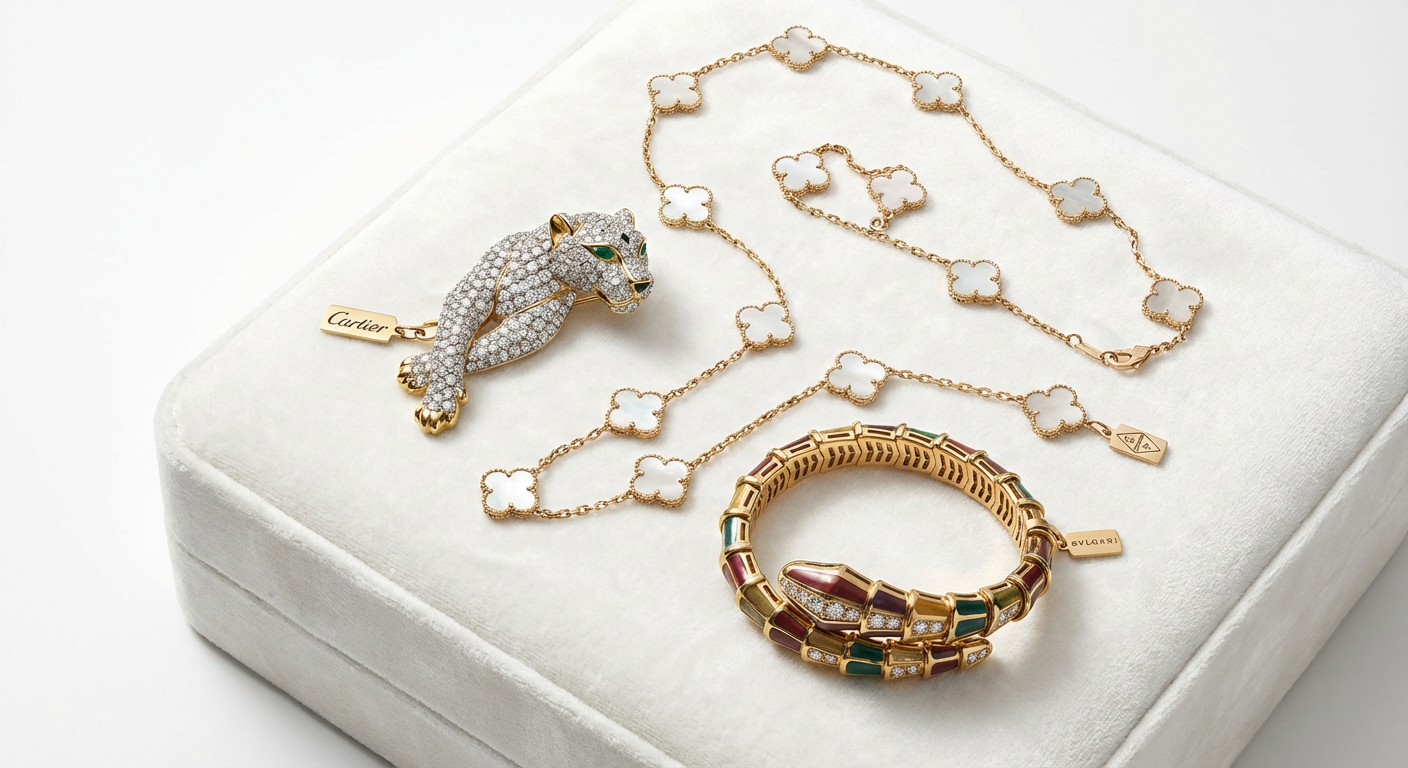
Next tier: Cartier, Van Cleef & Arpels, and Bulgari. These are the blue-chip signed houses. Their vintage pieces hold value reliably, authenticate clearly, and have deep secondary markets. Cartier panthère pieces, VCA Alhambra and Perlée, Bulgari Serpenti — these move at every major auction house and have predictable price ranges.
Third tier: David Webb, Seaman Schepps, Verdura, Fulco di Verdura. These are American design houses with devoted followings. David Webb's animal jewelry is as recognizable as anything from Paris. Schepps and Verdura have smaller markets but no less passionate collectors.
Below that: regional houses — Taxile, Boivin, Gripoix (the Paris costume jewelry houses), Damon, Kazanjian. Valuable to specialists, harder to resell outside those circles.
At the bottom: unsigned pieces in the same styles. A vintage Hermes cuff is worth a fraction of a Boivin cuff in the same design, even if they look similar to an untrained eye.
Dealer's Notes
- ◆Buy the best signed piece you can afford within a category — signed always outperforms unsigned.
- ◆JAR and Hemmerle aside, the sweet spot for value is third-tier signed houses: David Webb, Schepps, Verdura.
- ◆Avoid buying 'inspired by' or 'in the style of' pieces as investments — they don't hold.
Authentication — Hallmarks, Signatures, and Construction Tells
Authentication is the most important skill in estate jewelry. Get it wrong and you lose everything.
Hallmarks are the first line of defense. French 18k gold is marked with a eagle's head; platinum with a dog's head (for dogue, French for mastiff); British sterling with a lion; Swiss 18k with a thunderbolt. But hallmarks are faked. Cartier and VCA have used consistent hallmarks for decades — learn what the real ones look like for each period. The London assay office date-letter system is publicly documented; use it.
Signatures are the most reliable authentication marker when you know what you're looking at. Cartier signed their pieces in multiple ways over the decades — 'Cartier Paris' with a numeric serial, 'Cartier' alone for earlier pieces, 'CR' for certain Retrospective line pieces. Van Cleef & Arpels used 'Van Cleef & Arpels' or 'VCA' or simply 'Arpels' for their earliest work. Bulgari uses 'Bulgari' or 'BVLGARI' depending on period. Study real examples at auction — Christie's and Sotheby's archive their catalog photography online for free.
Construction tells separate fakes from genuine pieces faster than any hallmark. Real Cartier links are seamless and perfectly symmetrical. Real VCA Alhambra beads are individually set with consistent beading. Real Bulgari Serpenti tubing is hand-coiled and has a specific flexibility. Fakes show tool marks, asymmetrical links, crude bezels, and wrong-weight gold.
The most faked pieces in the market: Cartier LOVE bracelets, VCA Alhambra pendants, Bulgari B.zero1 rings. These are mass-produced and worth studying — but they are also frequently counterfeited.
Dealer's Notes
- ◆Buy a loupe (10× minimum) and a UV light. Every estate purchase should be examined under magnification before payment.
- ◆For pieces over $5,000, get a written authentication from a specialist dealer — not an appraisal, an authentication opinion.
- ◆Red flag: a 'VCA' pendant with a toggle clasp instead of the signature lobster. Some fakes are obvious if you know the original.
Understanding Condition — What Matters and What Doesn't
Condition in estate jewelry is nuanced. Some wear is acceptable and even desirable; other wear is catastrophic.
Acceptable: light patina on yellow gold (natural and expected), minor surface scratches on platinum (polishable), slight thinning of gallery metal on old rings (normal for age), original enamel with normal craze lines (not chipping), secure but worn prongs that haven't lost stone security.
Acceptable and sometimes desirable: original finishes on Retro gold — the matte, textured surfaces on 1940s bracelets are part of their character. Don't let a jeweler 'restore' them to a high polish.
Never acceptable: replaced clasps on valuable bracelets (this destroys original integrity and value); re-shanked rings (entirely new shank means the original band is gone — a serious value killer for signed pieces); added diamonds or stones to fill in wear (this is fraud, not restoration); cleaned enamel on pieces that should have aged patina (Jewels by Liz for Gibbs pieces — cleaned enamel screams fake-vintage); rhodium plating over yellow gold to make it look like platinum.
For diamonds in estate pieces: expect some wear on facet edges. Old European cuts have a different optical character than modern brilliants — this is a feature, not a flaw. If the stones are recut to modern standards, you've lost part of the piece's historical integrity.
The rule: restoration should be invisible but reversible. Any work that permanently alters the piece — welding, re-shanking, recutting — should be disclosed and reflected in price.
Dealer's Notes
- ◆A replaced clasp on an Art Deco platinum bracelet can cut the value by 40–60%. Always ask.
- ◆Patina is your friend in yellow gold — 'cleaning up' a natural patina on a 1950s piece reduces its character.
- ◆Get a trusted jeweler to examine any stone-setting before purchase. A loose stone in a vintage piece is an emergency.
Where to Buy — Auction Houses vs Specialist Dealers vs Online
Each channel has a different risk/reward profile. Here's the unvarnished version.
Christie's and Sotheby's (New York, Geneva, Hong Kong): Best for pieces over $10,000 with solid provenance. The buyer's premium is 25–27% but the selection is curated and authentication standards are high. Their online-only auctions (Christie's Live, Sotheby's BID) have lowered the minimum threshold — you can now buy solid signed estate pieces for $2,000–$5,000. Disadvantage: no negotiation, no returns, inspection windows are limited.
Bonhams, Phillips, Hindman, Wright: The second-tier auction houses. Generally solid but less rigorous in authentication than the big two. Good for finding third-tier signed pieces at better prices. Know their specialists — some houses have excellent jewelry departments, others don't.
Specialist dealers like me: We have flexibility on price and condition disclosure that auctions can't match. A good dealer will let you examine a piece, offer a written guarantee, and take returns. You're paying a premium for service and accountability, not just the piece. For collectors building a relationship, this is the right channel.
1stDibs, Chairish, Ruby Lane: The online marketplace layer. Some exceptional specialist dealers here; also a lot of overpriced unsigned pieces being described as 'estate.' Always ask for detailed photos under magnification before purchasing. Authentication standards vary wildly by seller — check their return policy.
Instagram and eBay: I don't recommend either for estate pieces above $1,000 unless you're buying from a verified specialist account with a track record. The fakes are plentiful and the recourse is minimal.
Dealer's Notes
- ◆Auction buyer's premiums are non-negotiable. Factor them in before bidding — a $5,000 hammer price becomes $6,250 with premium.
- ◆At Christie's and Sotheby's, the estimates are often conservative. The final price is usually within 20% of high estimate for correctly attributed signed pieces.
- ◆Specialist dealers will negotiate. Auction houses won't. Use auctions when you're certain of value; use dealers when you need education.
Red Flags — What to Avoid
The estate jewelry market has more fraud than most people realize. Here are the patterns I see most often.
Cleaned and repainted enamel presented as pristine original. This is the most common deception in Art Deco enamel pieces. Original enamel has a specific luster and microscopic craquelure under magnification. Cleaned and repainted enamel is flat, glassy, and wrong. A repainted piece is worth 10–20% of a genuine original.
Re-shanked rings with no disclosure. Any competent jeweler can replace a shank invisibly. The problem: you've lost the original band, which carries all the diagnostic information about the piece's age, composition, and authenticity. A re-shanked Art Deco diamond ring is essentially a facelift with no before photos.
Added diamonds or stones. Sellers occasionally add diamonds to fill in wear patterns on old pieces — usually disclosed, sometimes not. Any addition should reduce your offer by at least the value of what's been added, because you've lost original integrity.
Wrong papers. Lab reports that don't match the stone — a GIA report for a different stone in the same mount, or a report that was issued before a repolishing that changed the clarity grade. Always cross-reference the report number with the GIA report database before paying.
Fabricated provenance. 'From a private New York collection' means nothing — this phrase is used universally. Specific provenance ('purchased at Christie's Geneva, Lot 247, 2019') is verifiable. Generic provenance is fiction.
Unsigned pieces marketed as 'attributed to' a house. Attribution is opinion, not fact. A piece attributed to Cartier by a dealer who isn't a Cartier specialist is worth what an unsigned piece is worth — the attribution doesn't hold at auction without documentation.
Dealer's Notes
- ◆If the price is too good to be true, it is. A 'signed Cartier' bracelet at $800 is not a Cartier bracelet.
- ◆Always request a written condition report from the seller before purchase. Vague responses to specific questions are a red flag.
- ◆For pieces over $3,000: get a second opinion from a specialist dealer before payment. Any reputable seller will allow this.
Price Ranges by Category
Here are realistic retail price ranges for estate signed pieces — what you'd pay buying from a specialist dealer or at auction, before buyer's premium.
Art Deco platinum bracelets (unsigned or third-tier signed, e.g., Rabun, Lacloche): $3,000–$25,000 for exceptional pieces. Well-made unsigned Deco bracelets in platinum with old European cuts are the best value in the market — beautiful, wearable, and underpriced relative to their signed counterparts.
Art Deco platinum bracelets (Cartier, VCA, Bulgari): $25,000–$200,000+. Cartier's Deco output is the benchmark. Anything with original documentation is premium-priced.
Van Cleef & Arpels Alhambra (vintage gold, various stones): $3,000–$15,000 depending on stone and condition. Vintage Alhambra with genuine Malachite or Onyx on yellow gold is the sweet spot.
Cartier LOVE bracelet (vintage 18k, with screwdriver): $4,000–$12,000. Yellow gold vintage Love bracelets are consistently in demand.
Cartier Panthère pieces (brooches, rings): $10,000–$500,000+. The panthère is Cartier's most valuable motif. A vintage panthère brooch in pavé can reach six figures easily.
Bulgari Serpenti (vintage Tubogas): $5,000–$50,000+. The iconic 1970s Serpenti pieces in two-tone gold are mid-range. Full pavé diamond Serpenti from the 1990s–2000s are the high end.
David Webb animal jewelry: $3,000–$25,000 for standard animals; $15,000–$75,000 for zebras, dragons, and the iconic enamel-implemented designs.
JAR: $20,000–$500,000+. JAR pieces appear at auction infrequently. When they do, they command whatever the market will bear — which is often well above estimate.
Unsigned Retro gold (1940s–1950s): $1,500–$8,000 for exceptional pieces. The Retro period produced extraordinary bold gold jewelry that is undervalued relative to its visual impact.
Dealer's Notes
- ◆The best time to buy at auction: January and August, when the market is thinnest and serious bidders are on vacation.
- ◆Art Deco platinum bracelets in the $3,000–$8,000 range are the most undervalued signed-adjacent pieces in the market.
- ◆Vintage David Webb and Seaman Schepps have among the best price-to-wearability ratios of any signed jewelry.
Building a Collection — Strategy and Priorities
Start with condition. A damaged signed piece is worth a fraction of an undamaged one, and repairs often destroy more value than they create. Buy the best condition you can afford — it holds, it wears, and you can eventually sell it without taking a bath.
Buy the best of each category rather than mediocre examples of expensive categories. A third-tier signed piece in excellent condition and rare design will outperform a second-tier signed piece with wear and damage. Condition and rarity trump house name within a reasonable tier.
Document everything. Keep the auction catalog or dealer receipt. Photograph the piece with measurements. If you acquire a GIA or AGL report with a stone, keep the original and a scan. This documentation supports future authentication and provenance claims.
Build relationships with specialists. A dealer who knows your eye and your budget will call you before a piece hits the market. Auctions don't offer this. A trusted dealer relationship is the best competitive advantage in estate jewelry.
Understand that some categories will outperform others. Signed Deco platinum, JAR, and vintage David Webb have the most consistent track records. Colored stones with original lab reports that include origin determination will appreciate as gemological documentation improves.
Finally: wear it. Estate jewelry was made to be worn. A piece that sits in a vault depreciates. A piece that circulates, that people see you wearing, that enters the social context of your life — that's when it becomes an asset in the fullest sense.
Dealer's Notes
- ◆Your first estate purchase should be something you'd wear regardless of its investment potential. If it doesn't speak to you, it won't hold your interest.
- ◆Keep a spreadsheet: purchase date, price, seller, condition notes, and any documentation. Update it annually.
- ◆Insurance: get a scheduled rider on valuable pieces. Standard homeowner's policies have low jewelry limits and don't cover mysterious disappearance.
Frequently Asked Questions
What makes signed jewelry more valuable than unsigned?
Signature establishes provenance, authentication, and design attribution. A piece with a verified house signature has a documented history, quality standards that were enforced at production, and an existing secondary market. Unsigned pieces require authentication from scratch every time they change hands — that uncertainty is priced into every transaction. Signed also means the piece was made to a specific house's quality standard, which is not replicable post-production.
How do I know if a piece is genuine Cartier?
Look at the signature first: 'Cartier' or 'Cartier Paris' with a serial number on the inside of the shank, clasp, or caseback. Then examine construction: Cartier links are seamless and symmetrical, prongs are consistent, hallmarks are stamped precisely. For valuable pieces, hire a Cartier specialist authentication. Christie's and Sotheby's both offer pre-sale authentication opinions for a fee.
What's the difference between estate, vintage, and antique jewelry?
'Estate' means any previously owned piece — no age requirement. 'Antique' means 100+ years old by legal/artistic definition (Georgian, Victorian, Edwardian). 'Vintage' has no fixed legal meaning but in practice means 20–100 years old (Art Deco, Retro, Mid-Century). In the trade, vintage and estate are often used interchangeably for pieces from the 1920s–1980s.
Does patina affect the value of estate jewelry?
It depends on the metal and the piece. Light natural patina on yellow gold is acceptable and often desirable — it shows age without damage and doesn't reduce value. Heavy tarnish or pitting on silver is different. On platinum, patina is minimal but surface scratches reduce Brilliance if not polished. Never let a jeweler 'restore' natural patina on a signed piece without understanding what will be lost.
Are replaced clasps a problem on estate bracelets?
Yes — almost always. A replaced clasp on a signed bracelet means the original hardware, which carries hallmarks, serial numbers, and construction characteristics diagnostic for authentication, is gone. A replaced clasp can reduce value by 40–60% on valuable signed pieces. Always ask about clasp history before purchasing.
Where is the best place to buy estate jewelry?
For pieces under $5,000: specialist dealers or 1stDibs with vetted sellers. For pieces $5,000–$50,000: Christie's and Sotheby's online auctions are the most reliable. For pieces over $50,000: major auction houses with full catalog auctions and specialist authentication. Avoid Instagram and eBay for high-value pieces — the fraud rate is too high.
Should I get estate jewelry insured?
Yes — schedule a separate rider on any piece worth over $5,000. Standard homeowner's and tenant's policies have jewelry sublimits (usually $1,000–$2,500) that don't cover high-value estate pieces. Scheduled coverage requires an appraisal (separate from authentication — different skill set) and covers replacement value.
Can estate jewelry be resized?
Usually yes, but it requires a skilled jeweler who understands vintage construction. Soldering on a signed piece risks disturbing the original metal work. Plique-à-jour enamel, fragile pavé, and tension-set stones should not be resized by anyone other than the house or a specialist vintage jeweler. Always disclose that a piece is signed estate jewelry before authorizing any sizing work.
Why are Art Deco platinum bracelets worth more than Retro gold ones?
Several reasons compound: Art Deco (1920s–1930s) platinum work required significantly more labor — platinum is harder to work than gold, and the jeweler's skill required was higher. The design vocabulary of Deco is considered the apex of jewelry design by most collectors. Platinum holds diamonds more securely than gold prongs. And fewer Deco platinum bracelets survived — gold was melted down during WWII, platinum was not produced for civilian use from 1940–1947.
How do I verify an auction estimate is realistic?
Research the last 3–5 auction results for comparable pieces. Christie's and Sotheby's both publish their archives online — free, searchable by keyword, with realized prices. A realized price within 20% of the high estimate for a correctly attributed signed piece is normal. If estimates seem high relative to comparables, either the attribution is being tested at auction or the house is being optimistic.
Related Guides